Mon-Sun · 07:00-23:00





 Daily:
7:00-23:00
Daily:
7:00-23:00

Padel is a racket game played two against two on a small court enclosed by glass walls and mesh. After bouncing on the ground, the ball can hit the glass and stay in play, which is where padel resembles squash. Scoring works like tennis. You serve underhand, and the racket is short and has no strings, so you get real rallies within your first minutes on court. No special preparation is needed.
That is padel in a nutshell. Below are the details: what the court looks like, the rules, how padel differs from tennis and squash, where to try it in Chișinău and how much it costs.
The court: 10×20 metres, glass and mesh
A padel court measures 10 by 20 metres. A doubles tennis court is almost 24 metres long and 11 wide, not counting the run-off around it. The padel court is split in half by a net, and each half has a service line and two boxes you serve into.
The main difference is obvious at first sight: the court is enclosed all around. The back walls and corners are glass, and the sides are finished with metal mesh. The ball hardly ever leaves the court, nobody has to go fetch it, and play barely stops.
How the walls work
There is one rule. The ball must first touch the ground on your opponent’s side. After that it may hit the glass, and it can still be returned as long as it has not touched the ground a second time.
If the ball hits your opponent’s glass directly, without bouncing on the ground first, it is out. You may use your own wall: hit the ball into your own glass so that it goes back over the net. Beginners rarely do this, but it is allowed.
In practice, the wall gives you a second chance. In tennis, a ball that has passed you is lost. In padel you can turn around, wait for it to come off the glass and play it calmly. That is why rallies are long even for first-timers.
Test yourself: is the ball in play?
Four situations from the court. Pick an answer and we will tell you why.
- The ball bounced on your side, hit the back glass and is coming back towards you.
- Your opponent hit hard and the ball went straight into your back glass without touching the ground.
- The ball bounced, hit the glass and touched the ground again before you reached it.
- You were late, hit the ball into your own glass, and it went over the net.
Padel rules in brief
- Always played in pairs, two against two. The court and rules are designed for four players.
- Underhand serve. The server stands behind the service line, drops the ball and hits it after the bounce, no higher than the waist. The ball goes diagonally into the opponent’s service box. You get two attempts, as in tennis.
- Tennis scoring: 15, 30, 40, game. Six games with a two-game lead win a set; at 6:6 you play a tie-break. A match is usually best of three sets.
- One bounce on the ground. A second bounce loses the point.
- Volleys are allowed, except when returning serve.
- You lose the point if the ball hits the net, hits the opponent’s wall without bouncing on the ground first, or touches a player.
That is all you need to know to start playing. The finer points you will pick up during your first game.
Racket and ball
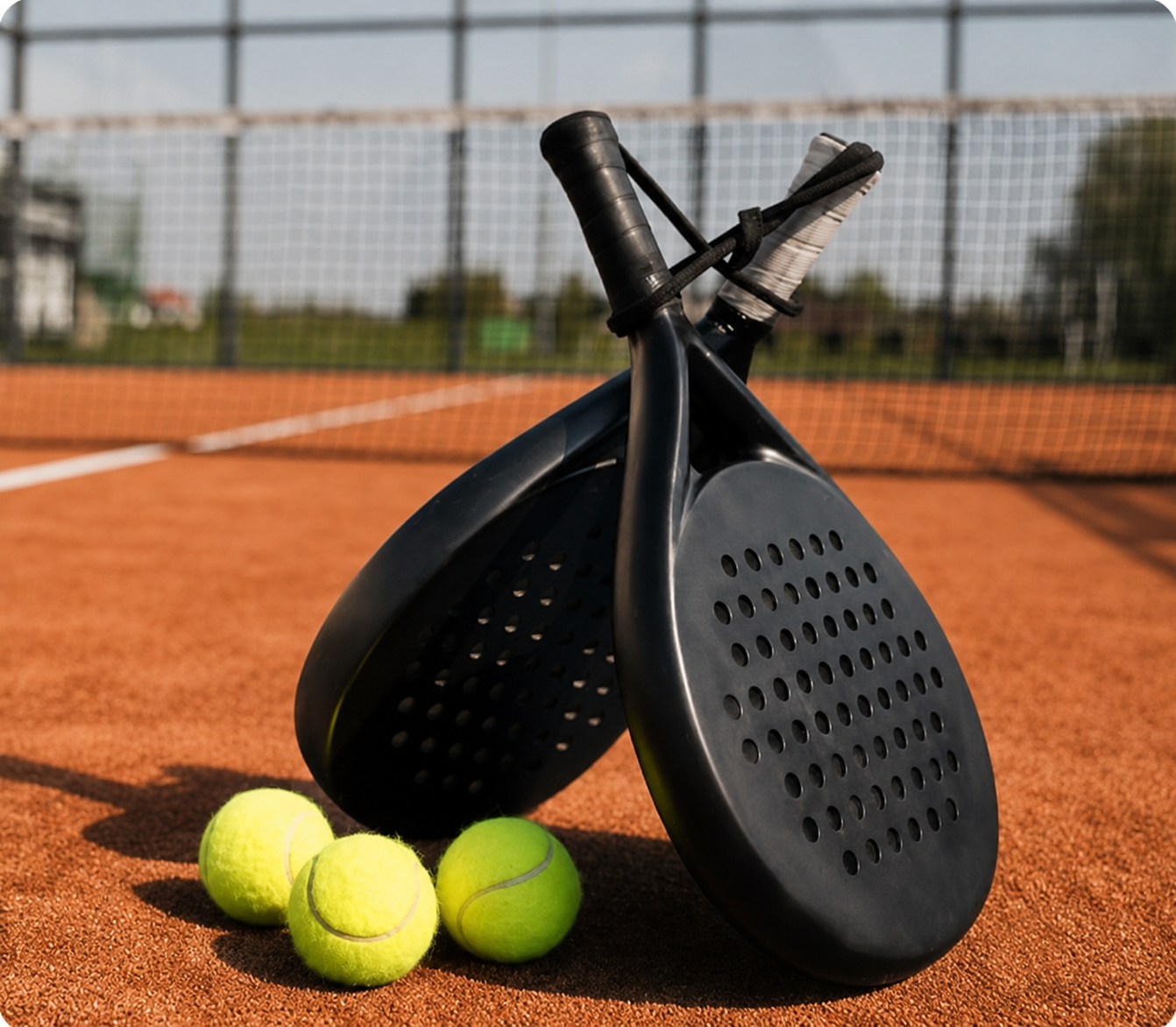
A padel racket is solid, with no strings. The hitting surface is perforated, and the handle has a strap you put around your wrist. The court is tight, your partner is close, and nobody wants a racket flying out of someone’s hand.
It is noticeably shorter than a tennis racket. The sweet spot is closer to your hand, so it is easier to hit the ball: it feels more like a beach racket than a tennis one.
The ball looks like a tennis ball but is softer and bounces lower. It travels more slowly and gives you time to get to it.
You do not need to buy a racket for your first game. At Padel Point in Botanica, for example, rackets are included in the court price. At other clubs, check when you book.
Padel vs tennis, and where squash comes in
Padel is often described as a mix of tennis and squash. From tennis it takes the net and the scoring, from squash the walls. Here is how the three games compare.
| Padel | Tennis | Squash | |
|---|---|---|---|
| Court | 10×20 m | 23.77×10.97 m (doubles) | 9.75×6.4 m |
| Walls | Glass and mesh, in play | None | Four walls, in play |
| Net in the middle | Yes | Yes | No, players share the court |
| Players | Always 2 vs 2 | 1 vs 1 or 2 vs 2 | Usually 1 vs 1 |
| Serve | Underhand, after a bounce | Overhead | Into the front wall |
| Racket | Short, stringless, with strap | Long, strung | Light, strung |
| Ball | Like a tennis ball, but softer | Tennis ball | Small rubber ball, low bounce |
| Scoring | 15-30-40-game | 15-30-40-game | Points, usually to 11 |
Why it is easier to learn than tennis
In tennis, the first months go into technique: the overhead serve, the long swing, footwork on a big court. Until you have the technique, the game is mostly walking after the ball.
In padel, three things remove that barrier. Anyone can serve underhand on the first try. The short racket forgives an imprecise shot. The walls give you back the ball that in tennis would be lost.
There is a fourth reason too: the court is small and shared by two. Each player covers a strip five metres wide, and any ball is two or three steps away. You run less and think more.
The difficulty comes later. Playing off the glass, overheads, positioning at the net: people spend years learning these, and there is no ceiling in sight. But the fun starts in the very first hour, and that is the key difference from tennis.
Do you need any preparation?
No. Padel does not require a powerful shot, a runner’s stamina or experience with other racket sports. Tennis, squash or table tennis experience helps, but you will be fine without it. People of different ages and fitness levels play comfortably on the same court.
If you want to get the hang of the walls and positioning faster, a lesson with a coach is worth it. Padel Point offers private and group training; details are on the services page.
Where padel comes from
The game was invented in Mexico in 1969, when Enrique Corcuera built walls around a court next to his house in Acapulco. From there padel spread to Spain and Argentina, where it became a mass sport.
Moldova has a Padel Federation, affiliated with the international federation since 2025. The national player ranking is kept on padelhub.md. The community is still small, so the easiest way to find partners at your level is through club chats.
Where to play padel in Chișinău
A padel club is simple: it is a venue with courts you rent by the hour, a bit like a bowling lane. Come as a group of four, pay for the court and play.
Courts in Chișinău are indoor or outdoor, and with our climate that matters. From November to March, outdoor courts mean rain, wet glass and early darkness, and at noon in July it is simply too hot.
Indoor courts:
- Padel Point Chișinău, 58/28 Dacia Blvd., STRAAL complex, Botanica. 9 indoor courts, about half of all courts in the city
- Divi Padel Club, 26 Andrei Doga St., Rîșcani. 2 courts
- Lemon Tree Padel, 18 Calea Moșilor, Rîșcani. 2 courts
- Squash & Padel City, 3 P. Halippa St., city centre. 1 court, about 400 lei/hour
- Kangaroo Squash & Padel, city centre. 1 court
Outdoor courts: iPadel Arena La Izvor in La Izvor park (2 municipal courts), Ursu Padel at 232 Vilor St. (1 court) and Primus Padel in Costești, outside the city.
How much it costs
You pay for the whole court, not per person. At Padel Point, court rental prices are:
- Mon-Fri 10:00-16:00: 300 lei/hour
- Mon-Fri 07:00-10:00 and 16:00-23:00: 500 lei/hour
- Sat-Sun all day: 500 lei/hour
Split four ways, that is 75 lei per person on weekday daytime and 125 lei in the evening or at the weekend. Rackets are included, and balls can be rented on site.
Calculator: how much each player pays
What to bring the first time
- Sportswear. Shorts or leggings and a T-shirt. Nothing special.
- Trainers. Tennis or indoor shoes are best. Running shoes with a high, soft sole give less support for sideways movement.
- A towel and a change of clothes. The Padel Point locker rooms have showers, and the complex has a sauna.
- Water. Or buy some on site: the club has a café.
- Three partners. If you have no group, players look for partners in the club’s Telegram chat.
No need to bring a racket: you will get one at the club.
The next step is simple: get four people together on a weekday. Between 10:00 and 16:00 a court at Padel Point costs 300 lei per hour, which is 75 lei per person, rackets included. Book a court online at padelpoint.md or call +373 78 003 100; the club is open daily from 07:00 to 23:00.
Frequently asked questions
What is padel in simple terms?
A racket game for two against two on a 10×20 metre court with glass walls. After bouncing on the ground, the ball can come off the wall and stay in play. Scoring is the same as in tennis.
How is padel different from tennis?
The court is smaller and enclosed by walls that are part of the game. You serve underhand, the racket is short and stringless, and the ball is softer. It is only played in pairs and is much easier to learn.
Can you play padel with two people?
The rules and the court are designed for four players. If you are short of partners, you can find them in the Telegram chat t.me/padelpoint_md.
Do you need any preparation to start playing padel?
No. The underhand serve and short racket let you play from the first hour, without tennis experience or special fitness.
How much does it cost to play padel in Chișinău?
At Padel Point a court costs 300 lei/hour on weekdays from 10:00 to 16:00 and 500 lei/hour at other times. Split between four, that is 75-125 lei per person, rackets included.
Get four people together and come over: 9 indoor courts, rackets included.
Book a court