Mon-Sun · 07:00-00:00





 Daily:
7:00-00:00

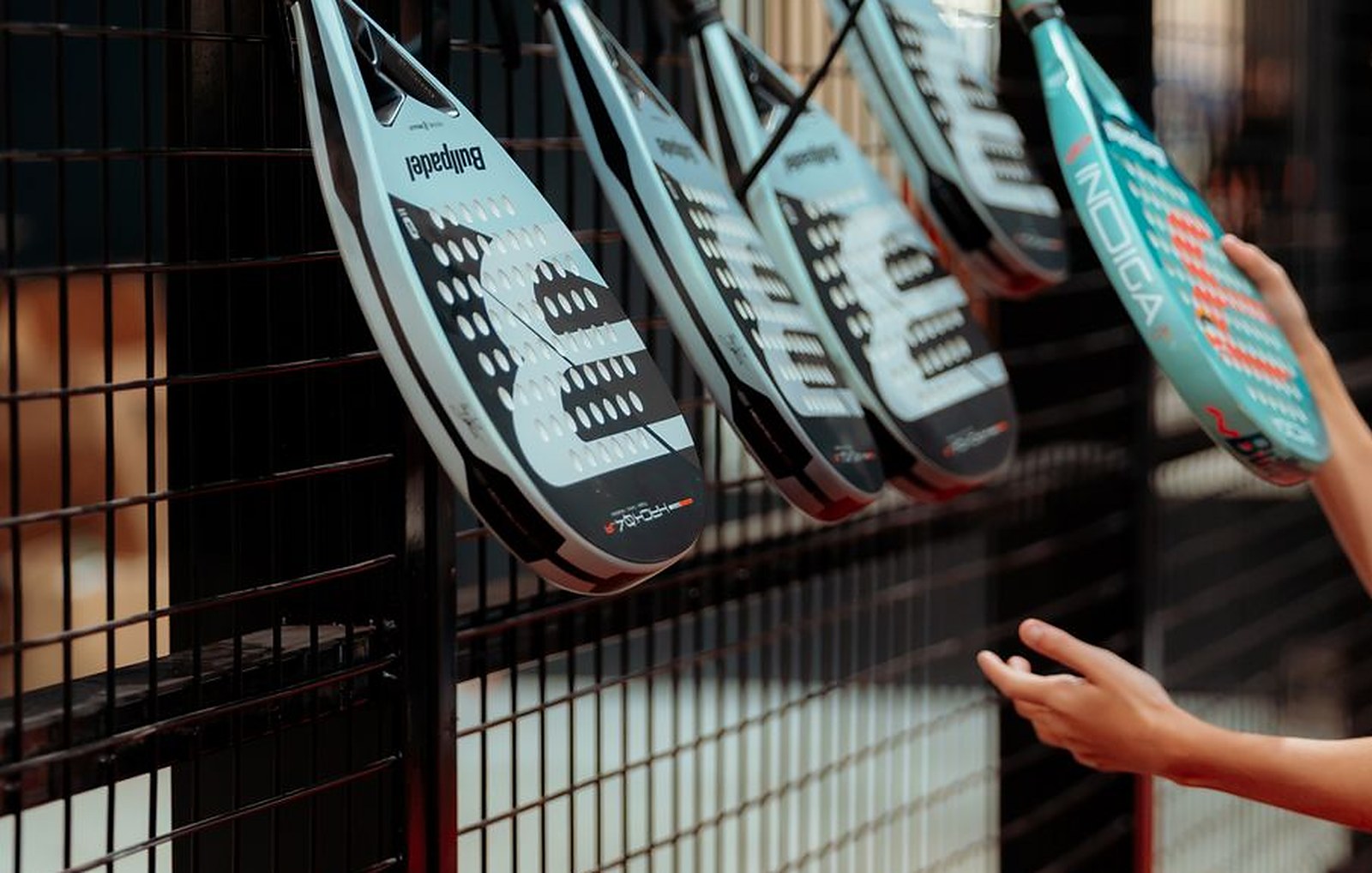
A beginner needs a round racket of medium stiffness and medium weight, and there is no need to buy one in the first month. At Padel Point rackets are included in the court rental, so play a dozen games with club rackets first, find out what you like, and only then go shopping.
Below is what to look at when that moment comes.
1. Do you need your own racket from day one?
No. Rackets and balls are included in the court price, and a club racket is more than enough for your first games. If you have not been on court yet, start with our piece on your first padel game and come back to this one in a month.
The reason is simple. In your first games you do not yet know how you hit: hard or carefully, at the net or off the glass, flat or with spin. And that is exactly what a racket is chosen for. A racket bought before your first game fits the picture in your head, not your hand.
The sensible moment to buy comes after 10-20 games. By then you know whether your arm gets tired, whether you lack power or, on the contrary, the ball flies into the glass, and which racket shape felt better in your hand. Then buying is a decision, not a lottery.
2. What the rules say
The International Padel Federation describes the racket in the official FIP Rules of Padel, edition applied from 1 January 2026. A few numbers matter to a buyer:
- Length including the handle: no more than 45.5 cm.
- Head width: no more than 26 cm.
- Thickness: no more than 38 mm.
- Hitting surface: perforated with holes of 9-13 mm in the central area; near the edge, holes of other shapes and sizes are allowed.
- Wrist cord: mandatory; non-elastic, no longer than 35 cm, fixed to the handle.
In practice, any racket from a known manufacturer fits within these limits, so there is no need to measure it. But two consequences are worth remembering. First, a tennis racket will not do for padel: it is longer, has strings and no wrist cord. Second, the cord is not decoration. Under the current FIP rules, if a player’s cord breaks or they drop the racket during a point, their pair immediately loses the point. So always wear it, even in a friendly game, and replace it when it is worn.
3. Shape: round, teardrop, diamond
The shape of the head determines where the best hitting point, the so-called sweet spot, is and how the weight is distributed. There are three shapes.
Round. The centre of gravity is closer to the handle, and the sweet spot is large and in the middle of the head. The racket forgives off-centre hits, is easy to handle and puts less strain on the arm. There is less power, but a beginner does not need power: their balls end up in the glass anyway.
Teardrop. Something in between. The sweet spot is slightly above the centre, the balance is medium. A bit more power, a bit less forgiveness. A good second step after a round racket, once your stroke is in place.
Diamond. The weight sits in the top of the head, and the sweet spot is small and high. Maximum power on a clean hit and minimum help on a miss. For players who hit overheads and attack at the net. For a beginner, such a racket mostly brings mishits and a tired shoulder.
| Shape | Sweet spot | Control | Power | Who it suits |
|---|---|---|---|---|
| Round | Large, in the centre of the head | High | Below average | Beginners, players who value precision, anyone whose arm gets tired |
| Teardrop | Medium, slightly above centre | Medium | Medium | Players with six months to a year of play who want more punch without losing control |
| Diamond | Small, in the upper part | Below average | High | Experienced attacking players with solid technique |
If in doubt, take the round one. People grow out of round rackets; from diamond ones they most often come back.
Find your racket in three answers
4. Weight and balance
Adult rackets weigh roughly 340 to 390 grams. As a rule of thumb: up to 355 grams is light, 355-370 is medium, over 370 is heavy. A 20-gram difference looks negligible on paper, but over an hour on court you clearly feel it.
A heavy racket gives power and stability, but it has to be accelerated and stopped several hundred times a game. If your arm is not ready for that, the load goes into the elbow and shoulder. An elbow that hurts after padel most often means a racket that is too heavy or too stiff, not a weak arm.
Balance tells you where the racket’s centre of gravity is. A low balance, with the weight towards the handle, makes the racket manoeuvrable and easy to control; that is typical of round shapes. A high balance, with the weight in the head, gives power and is typical of diamonds. Two rackets of the same weight but different balance behave like two different rackets: with a high balance, the same mass feels heavier.
A beginner is best served by a light or medium racket with a low or medium balance. So are former tennis players: being used to a heavy tennis racket does not help here, as padel movements are shorter and more frequent.
5. Stiffness and materials
Inside the racket is a foam core, outside a fibre shell. Their combination determines how stiff the racket is, and stiffness determines how it feels on impact.
The core. There are two kinds of foam. Foam is soft: the ball sinks deeper into the racket, the rebound is springy, vibration is dampened and the arm is comfortable. Good for control and for anyone protecting their elbow. EVA is denser and stiffer: it deforms less and gives more speed on a hard hit, but transmits more to the arm. EVA itself comes in grades from soft to hard, and manufacturers label them differently, so trust the feel rather than the label.
The shell. Fibreglass is softer and cheaper, adds springiness and forgives mistakes. Carbon is stiffer and lighter, transmits force more precisely and keeps its shape longer, but demands accurate hitting and costs more. There are also blends, with carbon in the frame and fibreglass on the surface.
For a start there is one rule: medium stiffness. A racket that is too soft will feel mushy after six months, and one that is too stiff will hit your elbow from day one. Medium gives you time to understand which way you want to go.
6. Surface: smooth or rough
The hitting surface can be smooth or rough, with a relief or a sprayed coating. The rules allow both.
A rough surface holds the ball longer on contact and helps with spin: slice and topspin shots become more noticeable. A smooth one gives a more predictable, cleaner rebound.
A beginner hardly feels the difference, because spin does not appear in their game before the second or third month. If you are choosing between two identical rackets, take the one that sits better in your hand, not the rougher one. Besides, the roughness wears off within a season, and a year later both rackets will be equally smooth.
7. Rackets for women, children and players over 40
For women. Marketing “women’s” rackets usually differ in colour and lower weight. Colour does not matter; lower weight is often useful, but look at the grams, not the name of the line. Round or teardrop shape, weight at the lower end of the adult range, foam or soft EVA in the core.
For children. Junior rackets are shorter and lighter than adult ones, and that matters: an adult racket in a child’s hand spoils technique and overloads the shoulder. Choose by height and age, not “to grow into”. The club runs separate training sessions for kids, and the coach will tell you when and what to move up to.
Over 40. The main criterion is comfort for the arm. A light or medium racket, low balance, soft core, round shape. This is no compromise in play: in padel, control and positioning matter more than power at any age, and a healthy elbow matters more than anything.
8. Five mistakes when buying your first racket
- Buying “what the pros use”. Pro rackets are more often diamond-shaped, stiff and heavy, because pros have different technique and a different arm. In a beginner’s hands the same racket becomes a source of mishits.
- Taking the stiffest one. Stiffness looks like a sign of quality. In fact it is a sign of load on the elbow, which nothing compensates for without a solid stroke.
- Taking the heaviest one. “Heavy means powerful” only works for those who can swing it fast enough. Everyone else gets late hits and a sore shoulder.
- Choosing by design. You should like your racket, but only after it fits in shape, weight and stiffness. A beautiful racket that does not suit you quickly ends up in the cupboard.
- Buying without trying. No table replaces ten minutes on court. A racket that is perfect on paper may not sit well in your hand, and vice versa.
Checklist before you buy
- At least 10 games played with club rackets.
- You know what you want to change: more control, more power, less strain on the arm.
- Round or teardrop shape, unless you already have a solid overhead.
- Light or medium weight, low or medium balance.
- Medium stiffness, foam or soft EVA core.
- The racket has been tried on court for at least one rally, ideally an hour.
- The wrist cord is checked: intact and firmly fixed to the handle.
- A cover and a frame protector come with it or are bought separately.
9. How to try before you buy
The cheapest way to test rackets is to play with club ones. At Padel Point they are included in the court price, and you can ask at the front desk which rackets are available: if there are different shapes, a few games are enough to compare them by hand rather than by description. A court costs 300 lei an hour on weekdays from 10:00 to 16:00 and 500 lei at other times, priced per court; details in our article how much padel costs in Chișinău.
The second way is to ask a coach. In a training session the coach sees your stroke from the side and in an hour will tell you more than any review: where the ball goes, whether your arm gets tired, which balance suits you. A private session costs from 800 lei an hour, a group session 150-250 lei per person in groups of up to four.
The third way is the club shop. There you can hold rackets, compare weight and shape and ask people who play themselves. We do not name models or prices here: the range changes, so it is better to come and see.
If you are short of partners for test games, you will find them in the players’ Telegram chat.
10. Looking after your racket
A racket lasts longer if you follow a few simple rules.
- Cover. Carry the racket in a cover, not in a plastic bag or loose. Scratches on the surface do not happen on court, they happen in the car boot.
- Frame protector. A strip along the top edge of the head protects it from chips when it touches the floor or the glass. It costs little, takes a minute to replace and saves the racket.
- Temperature. Do not leave the racket in the car in summer sun or winter frost. The core foam softens in the heat and loses its rebound, and becomes brittle in the cold. In Chișinău, the difference between a July car park and a January morning is about fifty degrees, and the racket remembers it.
- Do not hit the glass or floor. Hitting the glass or the court with the frame, in frustration or by accident, is the most common cause of cracks. A crack in the frame cannot be fixed, and the racket’s sound and rebound change after it.
- Wipe and check. Wipe the surface after playing, and check the frame and cord from time to time.
If the racket starts to sound dull or the ball comes off it unpredictably, the core has most likely worn out or the frame has cracked. That is the normal end of its life, not a defect.
11. Frequently asked questions
How much does a good first racket cost?
We do not quote specific amounts, as the range and prices change. A first racket does not need to be top of the line; most round mid-range rackets are fine for a start. As long as you play less than once a week, club rackets solve the question: they are included in the court price.
How long does a racket last?
Playing once or twice a week, usually one or two seasons. The core gradually loses its springiness and the surface wears. A crack in the frame or rim means the end straight away.
Will a tennis racket do?
No. Under the FIP rules, a padel racket is no longer than 45.5 cm, has a perforated surface and a mandatory wrist cord. A tennis racket fails on every point and is awkward to play with: it is long, and the ball comes in close to the body.
Round or teardrop for a first racket?
If you are not sure, round. It forgives more mistakes and strains the arm less. A teardrop makes sense once your stroke is in place and you want more power.
Why does my elbow hurt after playing?
Most often because of the racket: too heavy, too stiff or with a high balance. Less often because of technique, when the stroke comes only from the wrist. Try a lighter racket with a soft core and show your stroke to a coach.
Can I play without the wrist cord in a friendly game?
Better not. The cord is mandatory under the rules, and on a 10 by 20 metre court with your partner two steps away, a flying racket is dangerous. Get used to wearing it every time, and you will not have to remember it at a tournament.
An hour on court is more reliable than any review. Book a court online or by phone at +373 78 003 100, ask at the front desk which rackets you can try, and compare. The club is open daily from 07:00 to 00:00, nine courts in an enclosed, warm hall at 58/28 Dacia Blvd., Botanica. And if you do not know yet what padel is, start there; the racket can wait.
Try different rackets before you buy: they are included in court rental from 300 lei. 9 courts in an indoor hall, daily 07:00-00:00.
Book a court